Timing Your Advocacy: When to Contact Congress for Maximum Impact
Learn the exact windows when contacting Congress has the most impact — from committee markups to the 24-48 hours before floor votes. Includes a year-round advocacy calendar.
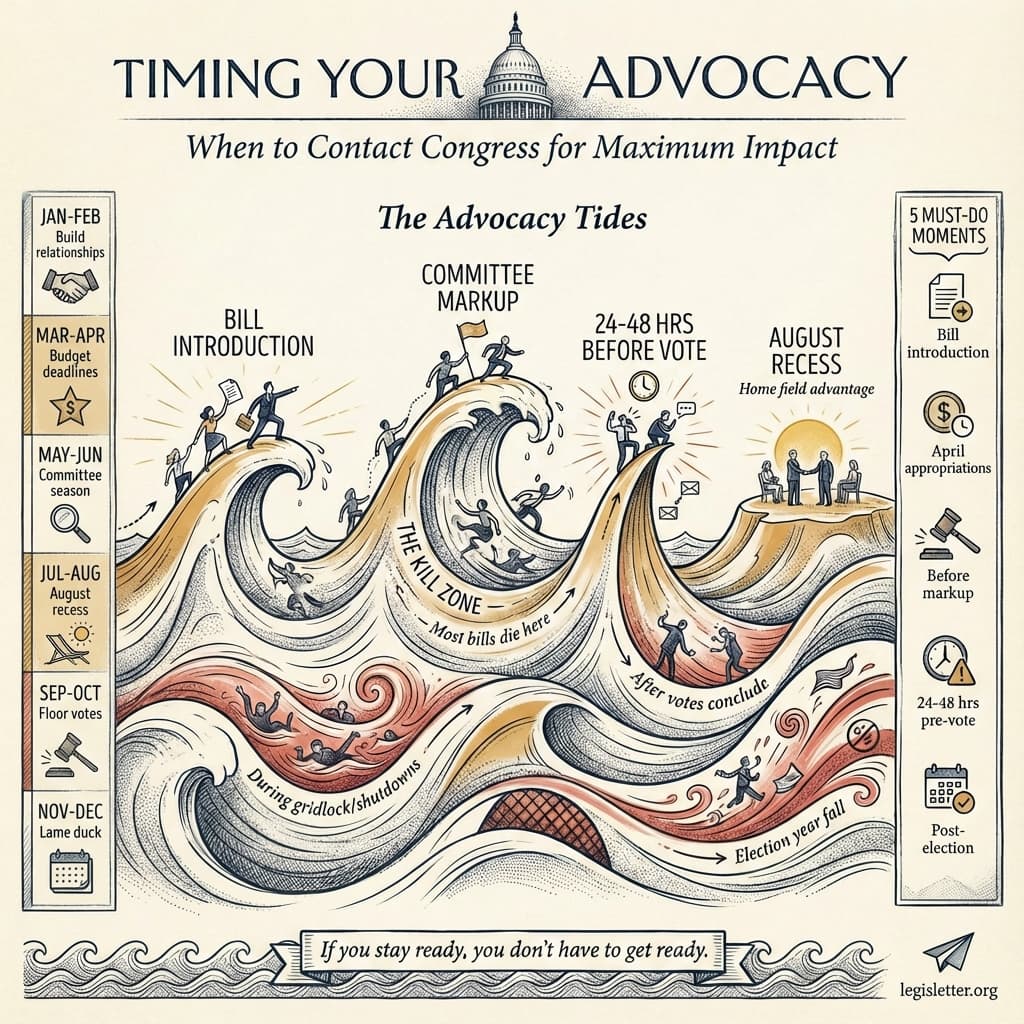
Grassroots advocacy isn't just about what you say to lawmakers—it's about when you say it. The timing of constituent outreach can make the difference between meaningful influence and a missed opportunity. Congress operates on a complex schedule of sessions, recesses, deadlines, and election cycles, all of which create windows of high or low impact for advocacy.
This guide breaks down the key timing considerations for engaging the U.S. Congress, from the yearly calendar to real-time legislative signals. If you're new to how a bill becomes law, start there first.
Congressional Recess Schedule: Sessions, Recesses, and Work Periods
Congress doesn't meet year-round. According to the House Rules Committee, the House typically meets around 147 days per year, the Senate about 165 days. The remaining days are recesses—periods when lawmakers leave Washington and return home.
Key recess periods include:
- Presidents' Day (February): One week
- Spring recess (Easter/Passover): Two weeks in mid-April
- Memorial Day: One week
- Independence Day: One week
- August recess: The longest break (4-6 weeks)—prime advocacy time
- Thanksgiving: One week
- Holiday break: Mid-December through early January
Why Recess Matters More Than You Think
Paradoxically, reaching lawmakers can be easier during recess. They have more time to focus on local concerns, and you're competing with fewer Beltway pressures.
According to the Congressional Research Service, during recess, members "leave Washington, DC, and travel to their home states and districts to begin a fast-paced schedule of constituent meetings, town halls, and other community events." In other words, they are actively listening.
Advocacy insight: If your representative is in the House, they'll likely be home most weekends and frequent one-week stretches. Senators may be in D.C. Monday through Thursday and only home Friday or during state work periods—but when they do recess, it's statewide outreach time.
Best Time to Contact Your Representative: Critical Windows
Understanding where a bill is in the legislative process determines when your advocacy matters most. Missing these windows can mean your support or opposition arrives too late.
1. Bill Introduction & Early Co-Sponsorship
When a bill is first introduced, the sponsor seeks co-sponsors to demonstrate support. Bills that quickly gain a large, bipartisan roster signal momentum to leadership. You can track co-sponsor counts in real time to spot bills gaining momentum.
Magic number (House): Per House Rule XV, bills maintaining 290+ co-sponsors for 25 cumulative legislative days can be placed on the "Consensus Calendar," offering a pathway to the floor even without committee action.
Advocacy window: Contact your legislators immediately after bill introduction to request co-sponsorship. Early momentum matters—a flurry of supportive calls right after a bill's unveiling can encourage fence-sitting legislators to hop on.
2. Committee Hearings & Markups (The "Kill Zone")
This is where most bills die. Committee stage is the single most important phase for advocacy.
The process:
- Bill referred to committee
- Subcommittee study and hearings
- Markup (line-by-line editing and voting)
- Committee vote to "report" bill to full chamber
Critical insight: If a bill is scheduled for markup, it's very likely to pass committee. The real battle is getting it scheduled for markup in the first place.
Advocacy windows:
- Before hearings (most critical): Shape whether the bill gets serious consideration
- Before markup: Once scheduled, you can still propose amendments or highlight concerns
3. When to Call Congress: The 24-48 Hour Window Before a Vote
Once a bill is scheduled for the floor, the final decision could be hours or days away.
Why the last 24-48 hours matter:
- Legislators are making final decisions
- Phone calls "force a staffer to stop all other work for several minutes"
- The "hierarchy of disruption" means calls and in-person visits signal urgency
Act fast. If you know a floor vote is imminent, mobilize immediately: send action alerts, organize telephone trees, leverage social media tagging of the legislators. Tools like the Call Congress App make it easy to connect advocates with their legislators' offices in seconds.
Example: During the 2017 ACA repeal effort, constituents jammed phone lines urging key senators to oppose "skinny repeal." A Kaiser Family Foundation poll found that 40% of Americans who were glad the repeal failed credited "the general public who voiced concerns about the bill."
4. Conference Committee Negotiations
When House and Senate pass different versions, a conference committee resolves differences. This stage is often less visible but critically important—provisions can appear or disappear in the final conference report.
Advocacy window: As soon as a conference is announced, target those conferees. The 1-3 week negotiation window is your last chance to shape the bill's content.
The Appropriations & Budget Cycle
If your cause depends on federal funding, timing your input into the budget process is vital.
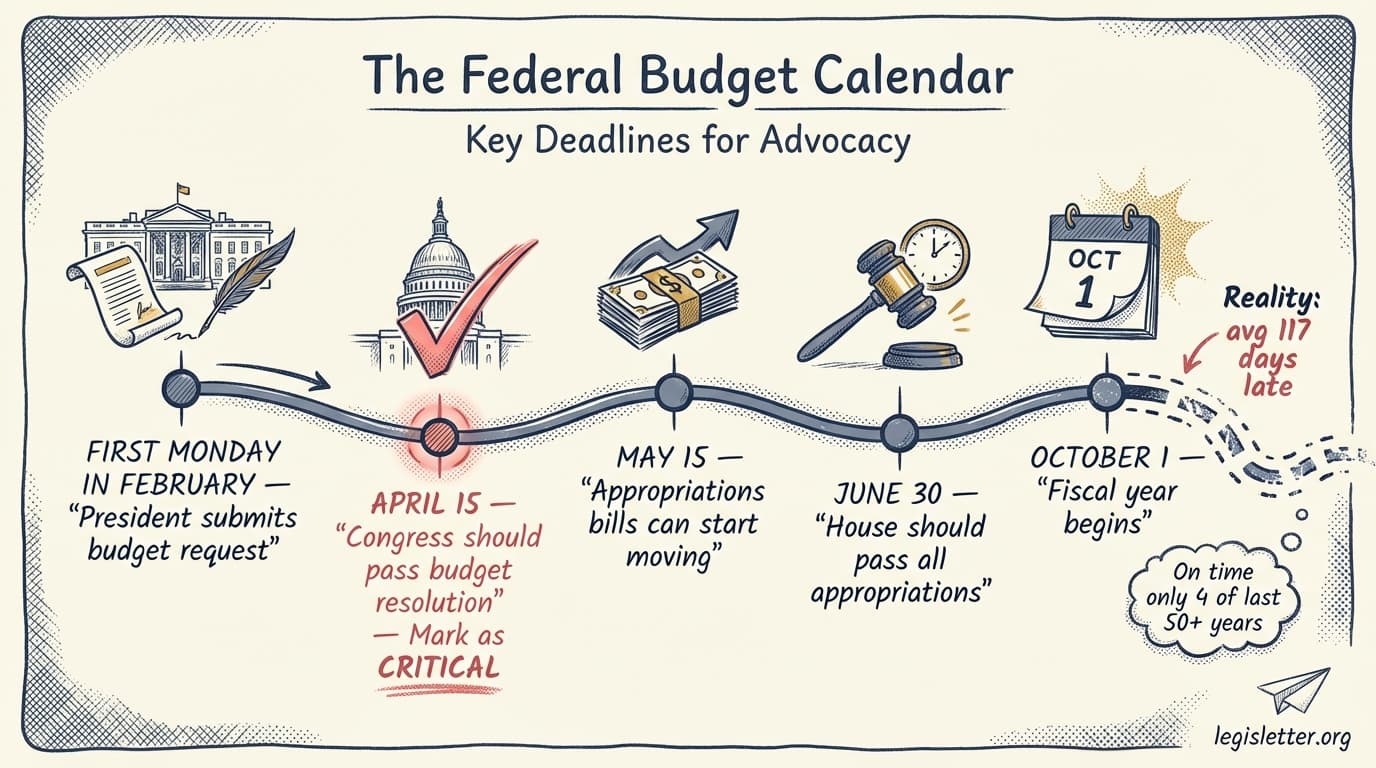
Congress has completed all appropriations on time in only 4 of the last 50+ years (1977, 1989, 1995, 1997). Since fiscal 1998, final spending bills have been 117 days late on average.
When Funding Advocacy Is Most Effective
Act early. The window for shaping appropriations is largely March through June.
February-March: Analyze President's budget. If your program is cut, mobilize Congress immediately.
April (CRITICAL): Member request deadlines. House constituent submission deadlines often fall mid-April. This is when your Representative needs data and justifications to champion your priorities.
September-October: CR negotiations. If a shutdown looms, highlight how it would harm your constituency.
November-December: Omnibus endgame. Refocus efforts on leadership and Appropriations chairs as final deals are struck.
Election Year Dynamics
Election years dramatically affect Congress's schedule and legislators' responsiveness.
Compressed Legislative Schedule
In election years, Congress has fewer working days. By September of an election year, Congress is often effectively done legislating on major issues.
Actionable insight: Aim to advance priority legislation by late spring or summer of an election year. After that, election fever takes over.
Heightened Constituent Sensitivity
Election season (months leading up to November) is when incumbents are extremely sensitive to public opinion. They're out campaigning, holding events, and reading local news daily.
Advocacy opportunity: Use summer and early fall to ask candidates their stance. August of an election year is usually filled with town hall meetings—showing up in numbers can pin lawmakers down on record.
Lame Duck Opportunities
The period after Election Day through early January can be a double-edged sword:
Opportunities:
- Legislators freed from electoral constraints may vote their conscience
- Major bipartisan deals have happened (2010 DADT repeal, 2001 DHS creation)
- Urgency to complete unfinished business
Risks:
- Time is tight (often only a few weeks)
- Leadership agendas dominate floor time
Does Calling Congress During Recess Work? Your Home-Field Advantage
Absolutely. Recess is not downtime for advocacy—it's action time on your home turf.
Town Halls: Golden Opportunities
Most members hold town halls during longer recesses. A pointed, well-framed question can elicit a commitment or at least signal that "people in my district care about this."
Town hall strategy:
- Coordinate so multiple people raise the issue from different angles
- Prepare concise fact sheets with local data
- Follow up: if the member says "I'll look into that," send a follow-up with additional resources
District Office Meetings
Meeting local staff can be as influential as D.C. staff—they often brief the member when they're home.
Tip: Start reaching out a few weeks before a big recess to get on the member's schedule—they fill up fast. Not sure who represents you? Find your representative by address.
Site Visits
Invite your member to visit a relevant site: a clinic, school, factory, or community project. The impact of firsthand exposure can't be overstated.
How to Track Congressional Activity in Real Time
Stay alert to signals that indicate when an issue is heating up:
1. Cosponsorship Momentum
If a bill jumps from 5 co-sponsors to 50 in a week, it's a clear signal of momentum. Watch who is joining—committee chairs or party leadership signal the bill could get a look. The Legisletter legislative tracker surfaces bills gaining momentum so you don't miss these windows.
2. Committee Schedule Announcements
When a committee chair announces a hearing or markup, that's your "hurricane watch." Immediately gear outreach towards committee members.
3. Whip Counts and Close Vote Alerts
Media coverage reporting "the bill is a few votes shy" is a critical signal. Zero in on those swing votes with grassroots pressure.
4. Media Coverage Spikes
When your issue dominates headlines, members' offices are paying attention. Amplify and direct that energy toward your specific ask.
5. Leadership Statements
If the Senate Majority Leader announces "We plan to bring up X next month," that's a green light to push hard.
Nine Timing Mistakes to Avoid
- Contacting after votes conclude - The morning after is too late
- Missing the committee window - Most bills die here; don't ignore it
- Pushing during gridlock - Shutdowns and crises consume all bandwidth
- Tone-deaf timing around tragedies - Pause unrelated campaigns
- Constant "emergencies" - Creates fatigue and skepticism
- Overlooking district timing - Know when your Rep is on overseas trips or local events
- Ignoring election cycles - Don't start major pushes in election year fall
- Hammering locked votes - Shift to movable targets
- Forgetting regulatory timing - Agency comment periods matter too
The Five Must-Do Advocacy Moments
If you can only act at five critical times, make it these:
- Bill introduction - Request co-sponsorship immediately
- April appropriations window - Submit funding requests
- Before committee markup - Shape amendments and language
- 24-48 hours before floor vote - Phone calls matter most
- Post-election lame duck - Shape incoming members' agendas
Year-Round Advocacy Calendar
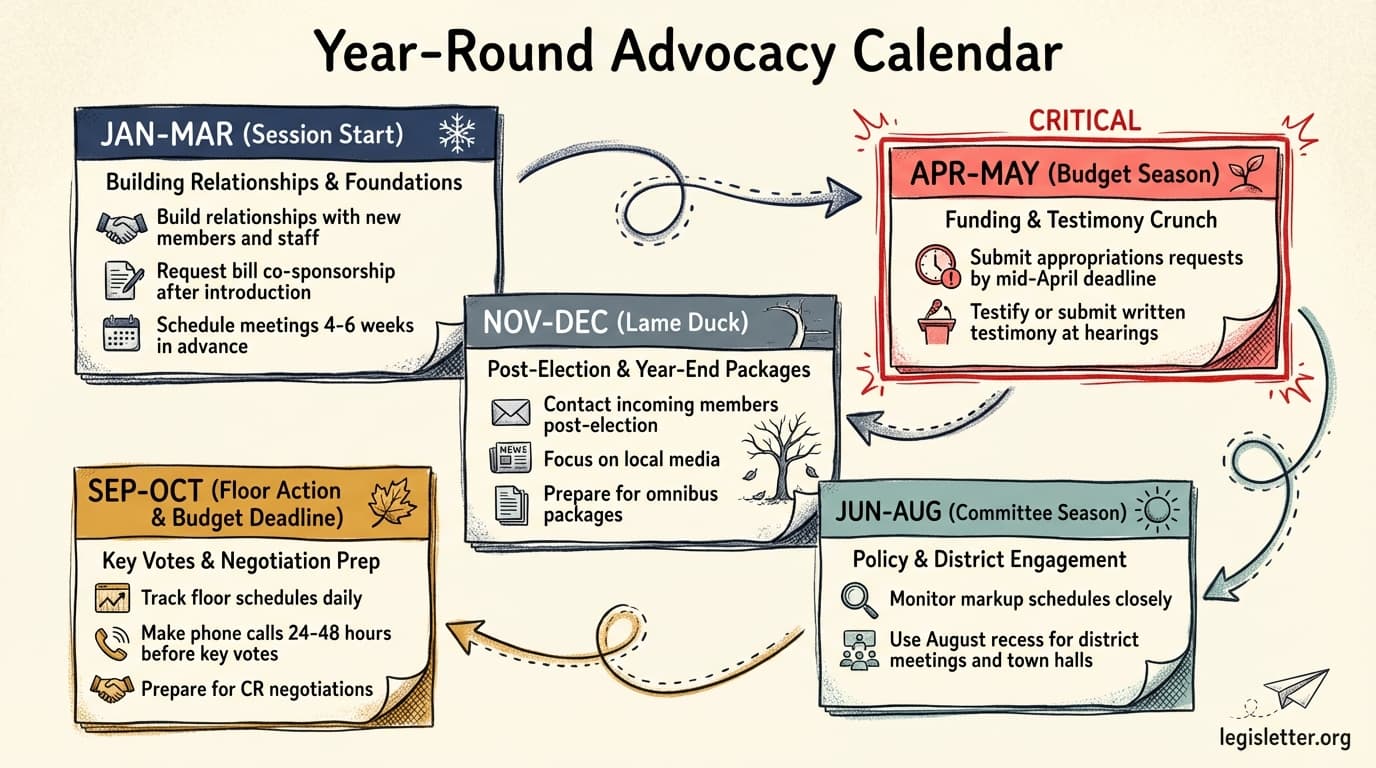
January-March (Session Start)
- Build relationships with new members and staff
- Request bill co-sponsorship immediately after introduction
- Schedule meetings 4-6 weeks in advance
April-May (Budget Season - CRITICAL)
- Submit appropriations requests (mid-April deadline)
- Testify or submit written testimony at hearings
June-August (Committee Season)
- Monitor markup schedules closely
- Use August recess for district meetings and town halls
September-October (Floor Action & Budget Deadline)
- Track floor schedules daily
- Make phone calls 24-48 hours before key votes
- Prepare for CR negotiations
November-December (Lame Duck)
- Contact incoming members immediately post-election
- Focus on local media (members are home more)
- Prepare for omnibus packages
The Bottom Line
Here's the truth: Timing isn't everything in congressional advocacy—but it's the difference between shouting into the void and changing votes.
Early engagement (committee phase, recess periods) beats late engagement (floor votes, lame duck desperation).
Relationship-building (district meetings, staff engagement) beats transactional asks (last-minute email blasts).
Strategic patience (multi-year campaigns, incremental wins) beats Hail Mary tactics (hoping 100,000 emails the day before a vote will flip members).
The most successful advocacy campaigns—from marriage equality to the 21st Century Cures Act—succeeded not because they had the most resources, but because they understood when to deploy those resources for maximum impact.
As the advocates say: "If you stay ready, you don't have to get ready."
Frequently Asked Questions
When is the best time to contact your congressman?
The single most impactful window is 24-48 hours before a floor vote — legislators are making final decisions and phone calls force staffers to stop all other work. Beyond that, committee markup stage and August recess are high-impact periods. During recess, members are home and actively listening to constituents.
Does calling Congress actually work?
Yes. Congressional staffers consistently report that phone calls are among the most effective forms of constituent contact because they "force a staffer to stop all other work for several minutes." During the 2017 ACA repeal effort, constituent calls were credited by 40% of Americans as the reason the repeal failed.
What is August recess and why does it matter for advocacy?
August recess is the longest congressional break — typically 4-6 weeks when members leave Washington and return to their home districts. It's prime advocacy time because legislators hold town halls, schedule constituent meetings, and are more accessible than during session. Think of it as your home-field advantage.
How far in advance should I contact my representative?
For scheduling meetings, reach out 4-6 weeks before a recess. For bill co-sponsorship, contact immediately after introduction — early momentum matters most. For appropriations requests, mid-April is the critical deadline. For floor votes, the final 24-48 hours are when your voice carries the most weight.
When is Congress in session in 2026?
The House typically meets around 147 days per year, the Senate about 165 days. The 119th Congress (2025-2026) follows the standard recess pattern: Presidents' Day (February), Spring recess (April), Memorial Day, Independence Day, August recess (4-6 weeks), Thanksgiving, and the Holiday break (mid-December through January). As a midterm election year, expect a compressed fall schedule as members campaign. Check the official congressional calendar for exact 2026 dates.
See Legisletter in Action
AI-powered campaigns, real-time bill tracking, and advocate verification — built for grassroots teams that move fast.
Book a Demo